

Where to Sit at Rate Field
Going to a game?
Some links on this page are affiliate links. If you book through them we earn a small commission at no extra cost to you. It never changes what we recommend.
Buying for a specific game?
Check the SunTrackerOne rule reorganizes seat shopping at Rate Field: a 100-level ticket lets you roam the whole park, up through the 300 and 500 levels, but the traffic never flows down. Ticket-checkers at the ramps keep 300 and 500-level tickets off the 100-level main concourse, and that concourse is where the headline food lives. The Sox are reportedly the only MLB club that runs its concourses this way. So the price of a seat is half the question here, and what the ticket lets you do for nine innings is the other half.
Lower Reserved (sections 108-110 and 154-156) is the weeknight value, Lower Box and Field Box are worth the step up on a marquee date, and the low rows of Upper Box (sections 522-542) are the best of the 500s if the lower bowl is out of budget, even though that ticket keeps you off the main concourse. The upper deck is still steeper than most parks even after the team tore off its top eight rows, so put anyone with bad knees or a fear of heights in the lower bowl. For a day game, shade lives under the upper-deck overhang.
Verify before you go: section numbering, tier names, and premium-club inclusions shift year to year. Confirm specifics against the Rate Field seating chart on mlb.com/whitesox before you buy.
The seating bowl
Rate Field opened in 1991 as the last big-bowl park before Camden Yards kicked off the retro era a year later, and the 2001-2007 renovations reshaped it: the top eight rows of the upper deck came off (about 6,600 seats), the deck was lowered, the Bullpen Sports Bar and the kids’ area went into the outfield, and the bullpens were moved into plain sight. Listed capacity is 40,615.
Main Level (100s). The lower bowl wraps from the right-field corner (the low 100s, visitors’ bullpen in front of sections 104-105) around home plate to the left-field corner (the 150s, Sox bullpen in front of 156-158, and the Bleachers at 160-164). The team sells this bowl in named tiers: Diamond, Platinum, Gold, and Silver Box across the infield, Field Box and Lower Box toward the midfield corners, and Lower Reserved, Outfield Reserved, and the Bleachers in the corners and outfield.
Club Level (300s). Mid-bowl seats above the main concourse with indoor club access, padded chairs, and in-seat service, sold as Premium Club Box, Club Box, and Club Corners.
Upper Level (500s). The upper deck, sold as Upper Box (522-542), Upper Reserved (510-520 and 544-558), and Upper Corners (506-509).
Outfield concourse. The Bullpen Sports Bar (a picnic-table restaurant under the outfield stands), the Craft Kave, the Miller Lite Landing, the Kids Zone, and Statue Row on either side of the Fan Deck in center.
The steep upper deck
The pitch of the upper deck is the seating fact most likely to surprise a first-timer here.
When the park opened in April 1991, the upper deck was pitched at roughly 35 degrees, against the 31 to 33 degrees typical of the retro parks that followed. The closest seat in the new upper deck sat farther from the field than the last row of old Comiskey’s upper deck, and higher. The complaints were loud, immediate, and well-documented in Tribune and Sun-Times coverage of the park’s early years, and the team occasionally closed upper-deck sections in high wind.
The 2001-2007 renovations (a roughly $118 million project) demolished the top eight rows across the park, cut about 6,600 seats, and lowered the deck. That removed the worst of it. What remains is the better portion of the original, and it is still steeper than the upper deck at most parks.
What that means when you buy is that an Upper Box or Upper Reserved seat is a real, usable seat with a defensible view, and the low rows behind home plate are the best of them. But if anyone in your group has bad knees, vertigo, or a thing about heights, buy the lower bowl and treat the difference as a necessity rather than a splurge.
Sun and shade
Rate Field is open to the sky, and a Chicago summer afternoon puts most of the bowl in full sun. The structural rule is the overhang, because the upper deck shades the covered rows beneath it. At a 1:10 start in July the sun sits high off the first-base side, so the third-base line looks straight into it, and by the end of the game it has moved around behind the first-base stands. That early, no side of the park is out of the sun, and the only shaded seats are the covered rows under the upper deck. As the afternoon goes on, the first-base side tends to be where the shade builds, and the seats that stay sunny longest are the open outfield sections and the rows out past the overhang. At a night game the sun goes down behind the grandstand rather than down either baseline, leaning a little toward the first-base side, so the infield bowl is out of the glare from first pitch, and the seats holding the last of that low light are the bleachers out in left-center, looking straight back into it. At a mid-May night game with a 6:40 first pitch, our seats in Section 154, Row 29, out in the lower bowl toward the corner, were fully in shade by 6:00. For a summer night game, expect most of the bowl to be out of the sun within the first few innings, and buy on price and sightline rather than shade. Chicago runs cold at both ends of the schedule, so at an April or late-September day game the sunny sections flip from problem to amenity. Shade is the amenity in July and sun is the amenity in April, so match the seat to the month rather than only to the price. For your own date and start time, check the Bleacher Bound SunTracker before you buy.
Premium clubs
The premium spaces have been rebranded and reshuffled across renovation cycles, so treat every name here as this season’s name.
Rate Club. The suite-level space directly behind home plate: padded chairs, weather protection, all-inclusive food and beverage, capped around 200 fans. It was the Guaranteed Rate Club from 2016 to 2024 and took the shorter name when the ballpark did. If a resale listing still says Guaranteed Rate Club, it is the same space under the old name.
Stadium Club. The long-running indoor club: buffet dining, full bar, field view through windows.
CIBC Scout Club and Diamond Suites. Field-level premium directly behind home plate: all-inclusive food and beverage, padded chairs, and in-seat service. CIBC Scout Club tickets have their own entrance at Gate 3 1/2, and Diamond Suite guests go in at the Gate 4 elevators.
Miller Lite Landing. The outfield premium: field-level views, leather chairs with armrests and cup holders, small TV screens, charging ports, $20 of loaded ticket value per seat, wait service, and group party areas.
These are for a group making a marquee weekend of it that wants weather protection and all-inclusive service. For a typical weeknight, a lower-bowl ticket plus a concourse dinner is the better night.
Bullpen Sports Bar. It is not a premium club, but you should know about it anyway. It is a sit-down restaurant with picnic-table seating under the outfield stands. On an earlier visit we watched from those tables at what felt like field level. Seating is first-come, first-served, so arrive early if you want the front of it.
Outfield seats
- The corners. The low 100s are the right-field corner and the 150s and Bleachers are the left-field corner. The dimensions are symmetric (330 feet to each pole), so neither corner is unusually home-run-friendly.
- Bullpen views. The visitors’ bullpen sits in front of sections 104-105, the Sox pen in front of 156-158. Front rows there watch relievers warm up all game; however, the pen sits between you and the field.
- Fan Deck and Statue Row. The center-field standing area, with the bronze statues of Sox greats on either side. Do the statue walk once, before the game, take the picture, and get to your seat. You can find more about the full pre-game tour in our First-Timer Guide section.
- Craft Kave and Miller Lite Landing. Two outfield drink-and-watch spaces: the Craft Kave is a two-tier open-air section with food and bar service, and the Miller Lite Landing (the former “Goose Island” premium space) is a ticketed outfield section on the team’s pricing page.
- Kids Zone. The 15,000-square-foot kids’ area above the left-field concourse: youth-sized diamond, batting and pitching cages, base-running area, staffed instruction. It opens with the gates, runs all game, and is reachable from the 100, 300, and 500 levels, an exception to the concourse rule.
Cheapest seats and standing room
The cheapest seated ticket is typically in the upper deck or the far corners of the lower bowl. Standing-room inventory exists for some games but is not advertised the way it is at Wrigley or Coors.
The cheap seat worth buying is low-row Upper Box behind home plate (sections 522-542, rows 1 through 10). What survived the renovation is the lower, closer portion of the original deck, and from those rows the sightline is centered on the infield. One warning is that a 500-level ticket cannot reach the 100-level concourse, so the Cuban Comet sandwich at section 148 and the jibarito at 104 are off your map for the night. If eating well in the park is part of the plan, the step up to a Lower Reserved ticket buys back the whole main concourse.
Wheelchair-accessible seating
Rate Field has more than 400 wheelchair-accessible seats across all levels. Main Level accessible sections include 104, 109, 110, 118, 119, 133, 144, 145, 154, 155, and 160. Accessible seats on the Club (300) and Upper (500) Levels are sightline-accessible, Diamond Suite levels are accessible, and companion seating is sold adjacent.
Buy at the box office at Gate 4 during business hours; wheelchair-accessible ticket windows are also at Gates 3 and 5. Wheelchair escorts from any gate to the seat can be arranged with uniformed staff at the gate, and exit escorts through the guest relations booth. The Gate 5 team store and all gift shops are wheelchair-accessible. The park has 38 public restrooms, 12 escalators, and 13 elevators across the concourses.
Best-value sections
Start with the access rule, because we got it wrong ourselves. At the Crosstown Classic last May we sat in Section 154 with 100-level tickets and spent the whole game assuming the ramps were closed to us in both directions. They were not. A 100-level ticket roams up to the 300 and 500 concourses freely, and only the downward direction is blocked. The Sox do not publish a reason for the policy, but watching the 100-level bathroom lines back up on a Crosstown Friday suggests one practical reason.
The tiers, using the team’s official names (the same names you will see as filters on StubHub and the other marketplaces):
- Lower Reserved (108-110 and 154-156) on a weeknight. The back corners of the lower bowl. You keep the full run of the park, and the sightlines are clean.
- Lower Box (111-113 and 151-153) or Field Box (114-118 and 146-150) on a marquee date. A notch in toward the infield. On a Crosstown or Yankees weekend the whole bowl is in demand anyway, and the in-game experience is meaningfully better for a fan who came specifically for the baseball.
- Upper Box low rows (522-542) if the lower bowl is out of reach. The best sightline in the 500s, with the concourse lockout as the cost.
Our seats taught us that the corner sections do not point at home plate. Section 154 faces the outfield, so following the pitcher-batter action meant craning toward the plate all night. Mo sat behind the third-base foul pole the same evening, turned her head right for nine innings, and her neck hurt by the end. Lower-bowl corner and outfield sections at this park trade orientation for proximity, so if you are coming for the at-bats rather than the atmosphere, buy an infield tier. Two smaller notes from the same game: on marquee dates, expect steady aisle traffic mid-play in the lower bowl, and expect the concourses to move better than the crowd size suggests.
There is one exception to the lockout that families will care about. The Kids Zone reaches all three levels, so a 500-level seat does not strand the kids upstairs.
Obstructed-view warnings
Rate Field is a 1991 cantilevered bowl, so the steel posts of Wrigley (1914) and Fenway (1912) are not an issue here. The exception is the back rows of the upper deck and some corner sections, where the structure above can cut off the view of high fly balls toward the corners; the affected rows vary. Before buying a back-row upper-deck seat, run it through the team’s seat-selection tool on mlb.com/whitesox and look at the view.
How to find the right ticket
Weeknight games against AL Central opponents tend to be the easiest Rate Field tickets to find. The exceptions are the marquee dates: the Crosstown Classic against the Cubs is usually the highest-demand Sox weekend of the season, and Yankees, Red Sox, and Dodgers series tend to draw the biggest non-Cubs crowds.
Get Rate Field updates
Guide updates and the ballpark stuff, one email when there is something worth sending. No spam, no daily blasts, and we never sell your address.
Free. You'll get one confirmation email to click. Unsubscribe anytime.
- If the Crosstown Classic is the trip, add those games to your watch list.
If you would rather skip the alert and shop the resale market yourself, StubHub is the marketplace we partner with. These are resale listings, so prices can run above or below face value depending on the matchup.
Some links on this page are affiliate links. If you book through them we earn a small commission at no extra cost to you. It never changes what we recommend.
Photo gallery: the seating views
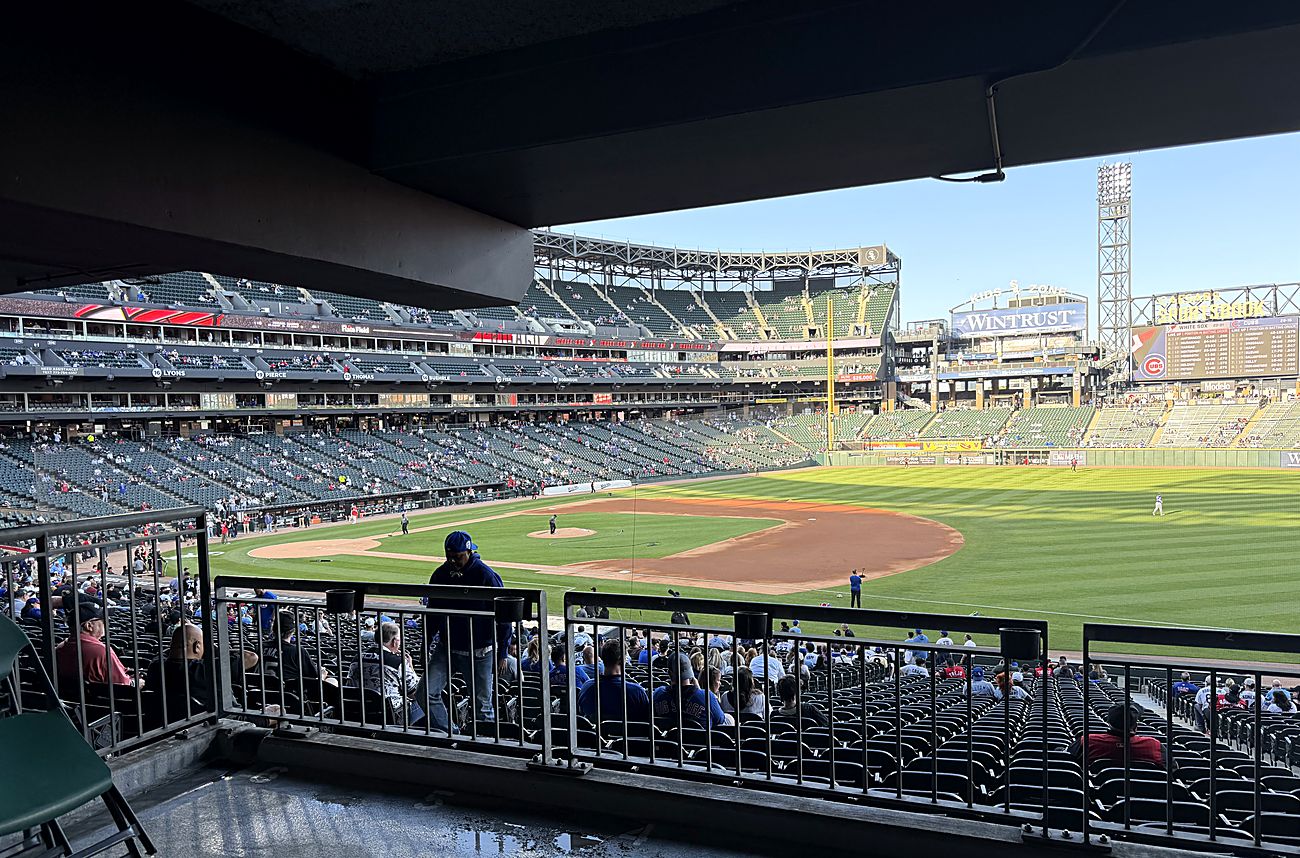

Know Rate Field better than we do? Tell us what we got wrong, or where we should be sending people instead.
Picking your seats?
Check the SunTrackerReady to lock it in?
Some links on this page are affiliate links. If you book through them we earn a small commission at no extra cost to you. It never changes what we recommend.