
Old Comiskey to Rate Field: the South Side's Ballpark
Going to a game?
Some links on this page are affiliate links. If you book through them we earn a small commission at no extra cost to you. It never changes what we recommend.
Rate Field is the fourth name on a building that has never moved: new Comiskey Park in 1991, U.S. Cellular Field in 2003, Guaranteed Rate Field in 2016, Rate Field since December 17, 2024. The park it replaced stood directly across 35th Street for 80 seasons, and that ground holds most of the franchise’s story: the 1919 Black Sox, Bill Veeck’s first exploding scoreboard, Disco Demolition. The current building has its own history, and it runs the full range: the 2005 World Series sweep that ended an 88-year title drought, Mark Buehrle’s no-hitter and perfect game two seasons apart, the worst record in modern baseball history in 2024, and a pope whose seat from Game 1 in 2005 is permanently marked in Section 140.
Old Comiskey Park, 1910 to 1990
Charles Comiskey built his ballpark at 35th and Shields in 1910, on 14 acres of former city landfill, and promoted it as the Baseball Palace of the World. The architect was Zachary Taylor Davis, who designed Wrigley Field four years later, so both of Chicago’s great ballparks came off the same drafting table. Davis studied at the Armour Institute, now the Illinois Institute of Technology, still on 35th Street near the park. The first game, July 1, 1910, was a 2-0 loss to the St. Louis Browns.
The old park earned its billing. It hosted the first All-Star Game in 1933, put in lights in 1939, and by 1971 it was the oldest ballpark still in use in the majors. The Sox closed it on September 30, 1990, with a 2-1 win over Seattle in front of a paid crowd of 42,849, and the replacement opened across 35th Street the next April. Old Comiskey’s home plate is still marked in the 35th Street sidewalk.
The 1919 Black Sox scandal
The heaviest event in franchise history happened at the old park. The 1919 White Sox won the American League pennant, then lost the World Series to the Cincinnati Reds five games to three (the Series ran best-of-nine that year), and eight Sox players were accused of conspiring with gamblers to throw it: Eddie Cicotte, Happy Felsch, Chick Gandil, Shoeless Joe Jackson, Fred McMullin, Swede Risberg, Buck Weaver, and Lefty Williams. A Chicago jury acquitted all eight on August 2, 1921, after key evidence, including the original confessions, disappeared from the grand jury files. It did not matter. The next day, August 3, new Commissioner Kenesaw Mountain Landis banned all eight from organized baseball for life, and the bans held for the rest of their lives.
The record has real complications, and Sox fans tend to know them. Jackson hit .375 in the Series, the best average on either team, with its only home run, which is why the debate over who actively threw games and who merely knew has never fully settled. Buck Weaver maintained until his death that he knew of the fix but took no money and played to win; every reinstatement request he filed was denied. Eliot Asinof’s 1963 book Eight Men Out is the canonical popular account, filmed by John Sayles in 1988.
The title drought that followed ran 88 years, long enough to earn its own name, the Curse of the Black Sox. The story also has a new final chapter: in 2025, Commissioner Rob Manfred removed the deceased banned players from the permanently ineligible list, which makes Jackson and the others eligible for Hall of Fame consideration for the first time.
Bill Veeck and the exploding scoreboard

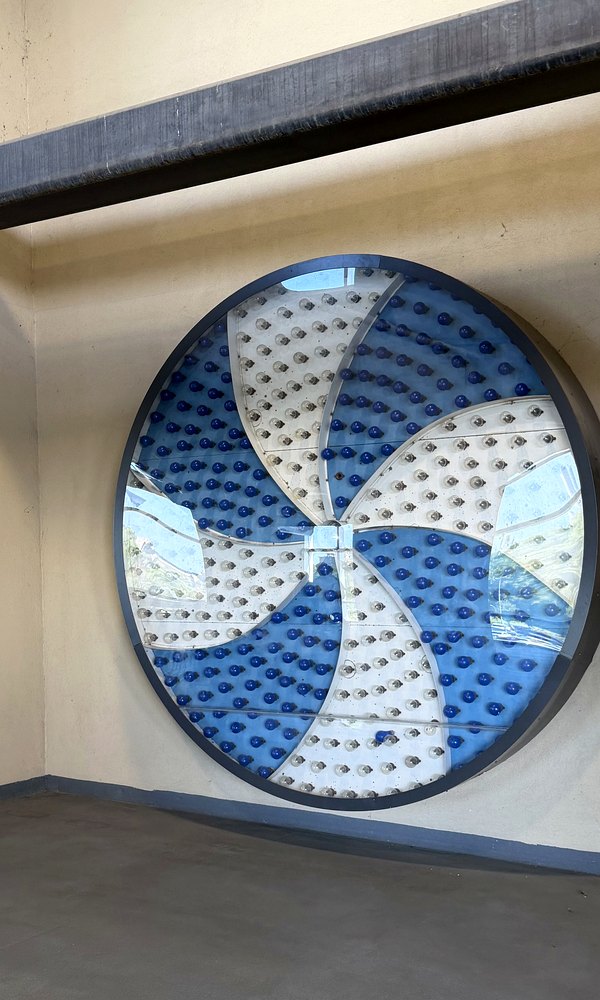
Every pinwheel and firework that follows a Sox homer traces to May 1, 1960. Bill Veeck, who owned the Sox twice (1959 to 1961, then 1975 to 1981), installed a $300,000, 130-foot scoreboard in center field at old Comiskey: fireworks, strobe lights, sirens, a message board, and spinning multi-colored pinwheels. Al Smith set it off first with a two-run homer off Detroit’s Jim Bunning in the bottom of the first inning. Veeck took the idea from a 1948 William Saroyan film, The Time of Your Life, in which a pinball machine erupts with lights and noise on the jackpot. He wanted a Sox home run to feel like that.
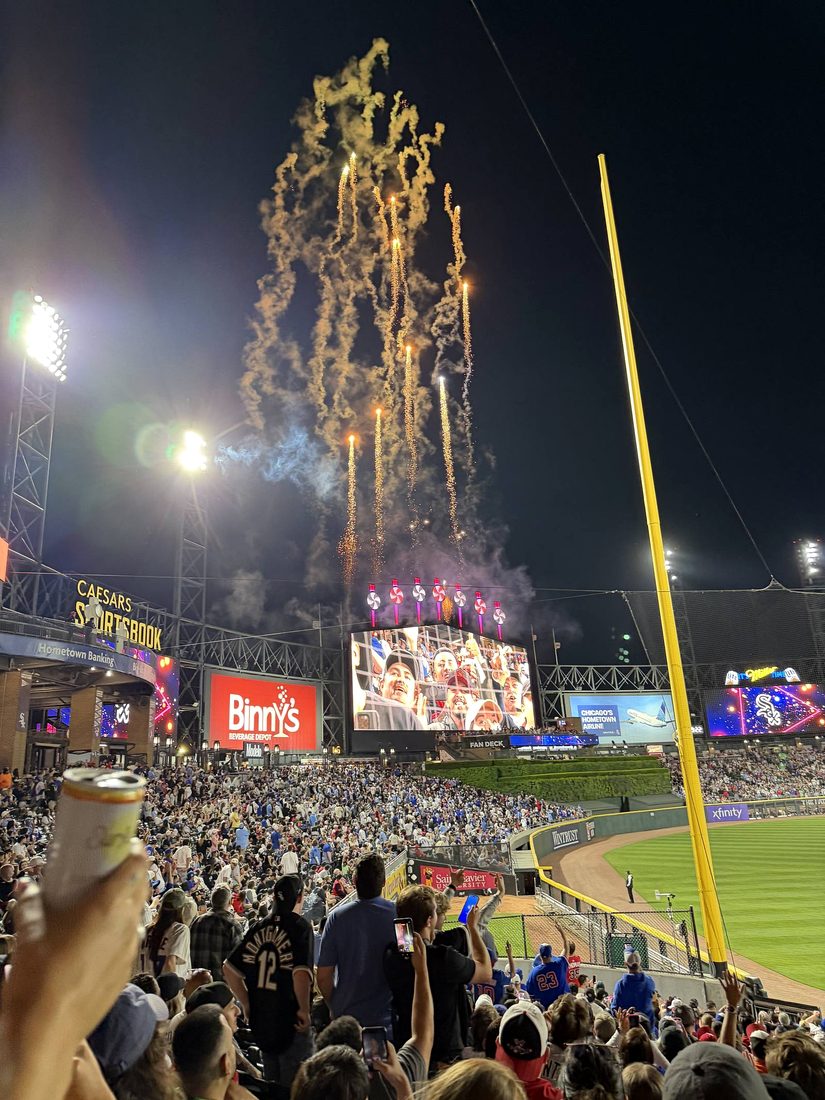
Veeck’s fingerprints are all over baseball. He put player names on the backs of jerseys in 1960, the first big-league team to do it, and back in 1951, running the St. Louis Browns, he sent 3-foot-7 Eddie Gaedel up to pinch-hit; Gaedel walked on four pitches. But the scoreboard is the invention that stayed attached to this franchise. The current board at Rate Field fires pinwheels and fireworks on a Sox home run, a straight line from 1960 to tonight.
Disco Demolition Night, July 12, 1979
This one happened at old Comiskey rather than the current park. People get that wrong constantly; the building you sit in did not exist until 1991.
The promotion came from Mike Veeck, Bill’s son and the team’s promotions director, with radio DJ Steve Dahl of WLUP: bring a disco record to the twi-night doubleheader against Detroit, get in for 98 cents, and watch the records get blown up between games. About 50,000 people came to a park that seated 45,000. Dahl dynamited the crate in center field, somewhere between 5,000 and 7,000 fans rushed the field, and for roughly 40 minutes they lit fires, tore up the turf, and broke equipment. About 39 people were arrested, the field was wrecked, and the Sox forfeited the second game to the Tigers.
“The day disco died” became the shorthand, but the record is more complicated than a punchline. Later coverage, including WTTW’s Chicago Stories, has examined whether the night’s real target was the music or the Black, Latino, and gay communities the music came from. Both readings are part of the history now.
The Go-Go Sox, the South Side Hit Men, and Winning Ugly
Three teams carried the franchise between the scandal and the new park. The 1959 Go-Go Sox, built on the speed and defense of Nellie Fox and Luis Aparicio, won the pennant, the franchise’s first since 1919, then lost the World Series to the Dodgers in six. Fox took the AL MVP that season.
The 1977 South Side Hit Men finished 90-72 on a Veeck shoestring budget, all bats and no pitching, with Oscar Gamble and Richie Zisk in the middle of the order. That summer is also the origin of the tradition Sox fans exported to the whole sports world: organist Nancy Faust started playing “Na Na Hey Hey Kiss Him Goodbye” when the opposing pitcher got pulled, the Comiskey crowd sang along, and the send-off spread to stadiums and arenas everywhere. The song was a 1969 number-one single by a studio act called Steam. The stadium tradition is Chicago’s.
The 1983 team won 99 games and the AL West, the first postseason trip since 1959, behind LaMarr Hoyt’s Cy Young season and a core of Carlton Fisk, Harold Baines, and Ron Kittle. Texas manager Doug Rader sniffed mid-season that the Sox “weren’t playing well. They’re winning ugly.” The Sox took the insult as a nickname and wore it the rest of the way, then lost the ALCS to a Baltimore team that went on to win the World Series.
The 2005 World Series
The 2005 White Sox went 99-63 and led the AL Central wire to wire. They went 11-1 in the postseason, tied with the 1999 Yankees for the second-best postseason record ever and behind only the 1976 Reds. Ozzie Guillen, a Sox shortstop from 1985 to 1997, managed them. They swept the defending-champion Red Sox in the Division Series, beat the Angels four games to one in the ALCS on four consecutive complete games from the rotation (Buehrle, Garland, Garcia, Contreras, in order), and swept Houston in the World Series, October 22 through 26.
The moments still get replayed on the South Side. Game 2: Paul Konerko’s grand slam in the seventh, then Scott Podsednik, who hit zero home runs in the regular season, ending the night with a walk-off shot in the ninth. Game 3 in Houston: Geoff Blum, a former Astro, winning it with a homer in the 14th inning of what was then the longest game in World Series history. Game 4: a 1-0 clincher, Jermaine Dye singling home the run in the eighth, Bobby Jenks closing. Dye took Series MVP. The drought it ended began in 1917, 88 years earlier. Journey’s “Don’t Stop Believin’” rode along as the unofficial anthem of the run and has surfaced at Rate Field when a moment earns it.
Buehrle: a no-hitter and a perfect game in the same building
On April 18, 2007, 16 years to the day after the park’s first game, Mark Buehrle no-hit the Texas Rangers, 6-0. He faced the minimum 27 batters. The only runner, Sammy Sosa, walked in the fifth and was picked off two pitches later. It was the first no-hitter in the park’s history and the 16th in franchise history.
Two years later, on July 23, 2009, he threw a perfect game against Tampa Bay, 5-0, in 2 hours and 3 minutes, the fastest perfect game since Tom Browning’s in 1988. The save everyone remembers came leading off the ninth: DeWayne Wise, inserted in center field that inning as a defensive replacement, went over the wall to take a home run away from Gabe Kapler. Josh Fields fielded a sharp grounder for the 27th out. It was the 18th perfect game in major league history and the second in Sox history, after Charlie Robertson’s in 1922. It also put Buehrle in a six-man club of pitchers with both a no-hitter and a perfect game: Cy Young, Addie Joss, Jim Bunning, Sandy Koufax, Randy Johnson, Buehrle. President Obama, a documented Sox fan, called him after the game.
Four names, one building
The park opened April 18, 1991, as new Comiskey Park, and Detroit spoiled the housewarming 16-0. The name carried over from across the street and lasted until January 2003, when U.S. Cellular bought the rights for $68 million over 20 years, ahead of the park hosting that summer’s All-Star Game. Fans shortened it to The Cell. Guaranteed Rate, a Chicago mortgage company, took over on November 1, 2016, in a 13-year deal reported at $20.4 million over ten years; the company’s logo on the signage was an arrow pointing down, and Sox fans did not miss the joke. Then Guaranteed Rate shortened its corporate name to Rate, and on December 17, 2024, the ballpark followed. If you searched Guaranteed Rate Field to get here, you are in the right place. It is the same building under its fourth name.
The building changed more than the signage did. A renovation cycle from 2001 to 2007, about $118 million, demolished the top eight rows of the upper deck (roughly 6,600 seats), lowered the deck’s height, moved the bullpens where fans can see them, and added the Bullpen Sports Bar and the 15,000-square-foot kids’ area now called the Kids Zone. The upper deck that drew a decade of complaints for its 35-degree pitch is still steep. The worst rows just no longer exist. You can find more about which of the remaining upper-deck rows to buy in our Where to Sit section.
The 2024 season
The 2024 White Sox finished 41-121, the worst record in modern major league history, meaning since 1900. They passed the 1962 Mets’ 120 losses on September 27, 2024, by dropping number 121 to Detroit. The season included a 3-22 start, 71 losses before the All-Star break (a major league record), and losing streaks of 14 and 21 games. Pedro Grifol was fired as manager on August 8; Grady Sizemore finished the season on an interim basis. The only big-league team ever with a worse record is the 1899 Cleveland Spiders, who went 20-134 in a pre-modern league so different that the comparison barely holds.
Since then the direction has been forward, slowly. Will Venable was hired on October 31, 2024, and his first team improved by 19 games to 60-102 in 2025, still last in the AL Central. The front office’s stated posture for 2026, year three of the Chris Getz rebuild, was another step forward rather than contention.
Pope Leo XIV and Section 140
No other park in baseball has this. On May 8, 2025, Cardinal Robert Prevost, born in Chicago in 1955 and raised a Sox fan on the South Side, was elected pope and took the name Leo XIV, the first American-born pope in the church’s history. His brother John settled the question every Chicagoan asks first, on the record with WGN: “He was never, ever a Cubs fan.”
The fandom turned up on film. Fox’s broadcast of Game 1 of the 2005 World Series caught then-Father Prevost in the crowd during the top of the ninth of the 5-3 win; he attended with Ed Schmit, a season-ticket-holding friend from St. Rita of Cascia parish on the South Side. The team identified the seat, Section 140, Row 19, Seat 2, and installed a permanent graphic there in late May 2025. Co-owner Brooks Boyer has said publicly that the pope holds an open invitation to throw out a first pitch, and that Leo told him he would “love to,” schedule permitting. It has not happened yet. He has, however, been photographed wearing a White Sox cap at Vatican appearances.
Hawk Harrelson
For a generation, White Sox baseball sounded like Ken “Hawk” Harrelson. He called Sox games from 1982 to 1985 and again from 1990 to 2018, with a year as the team’s general manager wedged between, and he was an open, unapologetic homer for all of it. The vocabulary is the legacy: “You can put it on the board… YES!” for a Sox homer, “He gone!” for an opposing strikeout, “duck snort” for a bloop hit, “Bolingbrook Bounce” for an infield hop that goes the Sox’ way. Neutral observers found the partisanship unprofessional; Sox fans heard one of their own with a microphone. Both sides were describing the same thing. His final call came September 24, 2018, a loss to the Cubs, and the booth has rotated since.
Statue Row
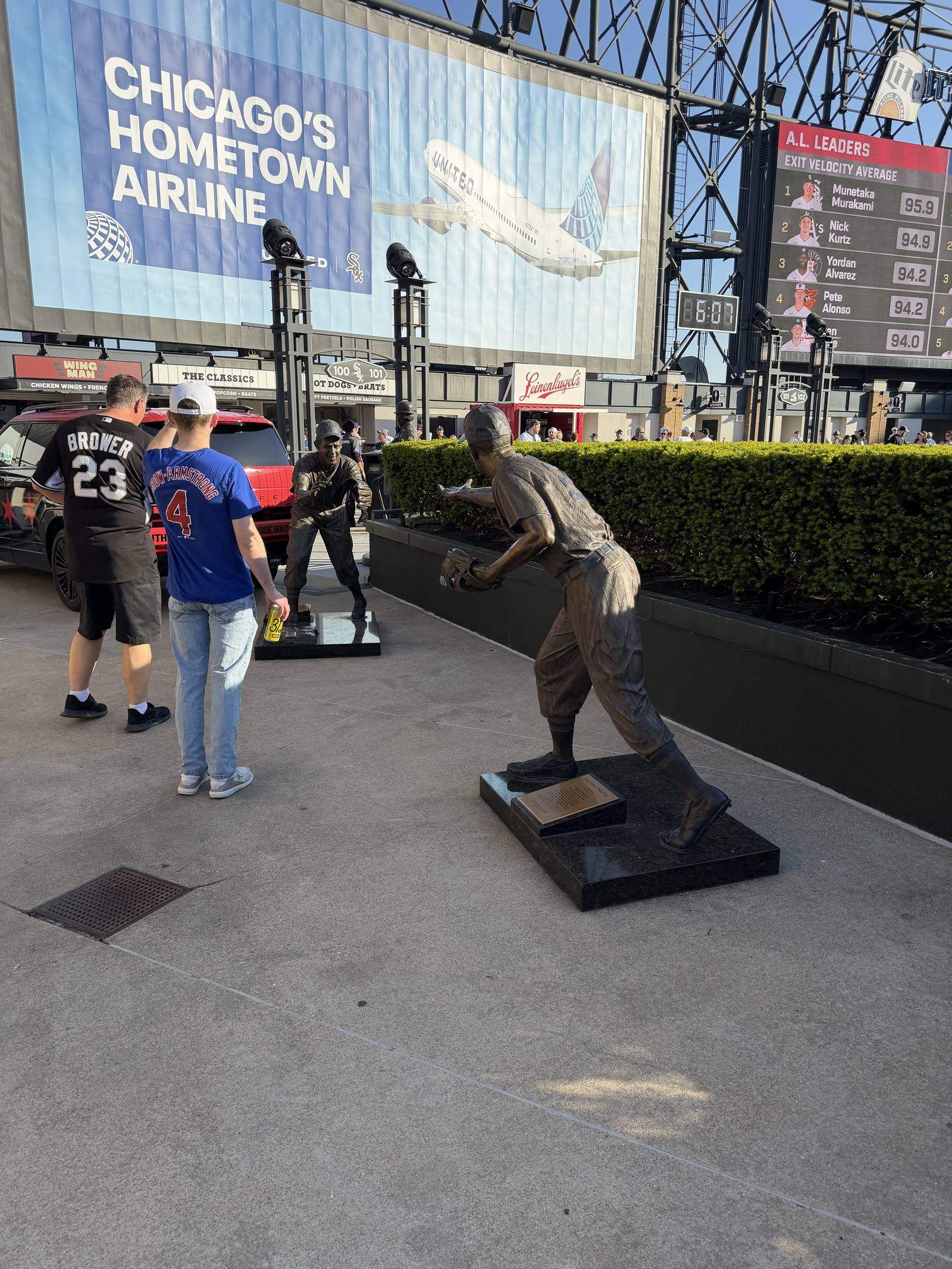
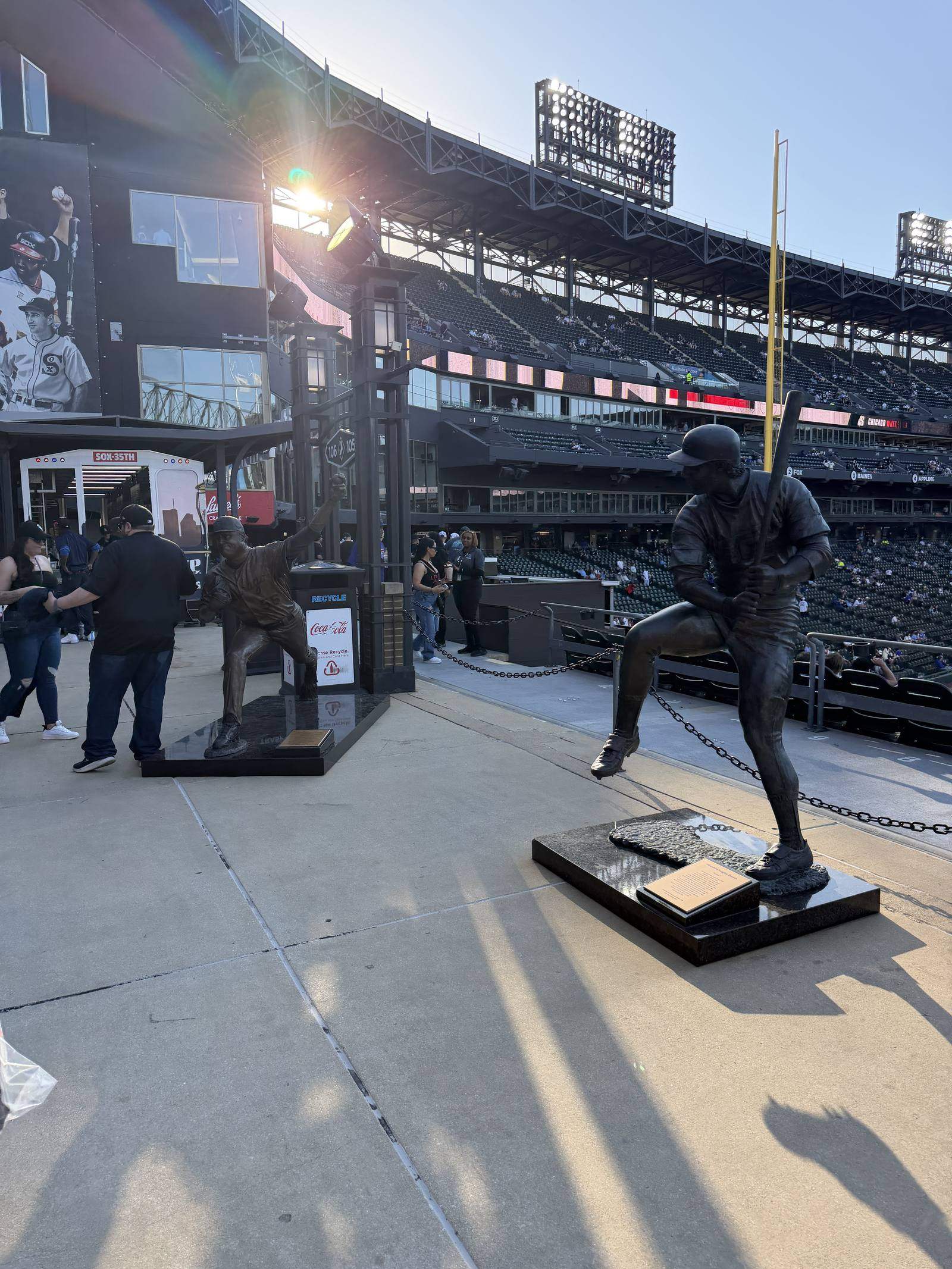
The outfield concourse carries bronze statues of the franchise’s greats, on either side of the Fan Deck, and there is nothing to pay once you are through the gate. One thing to plan around is that the outfield concourse is on the main level, so a 100-level ticket is the safest way to be sure you can reach it. The confirmed group: Charles Comiskey, the team’s founder, alongside player honorees Minnie Miñoso (the team’s first Black player, in 1951, and a Hall of Famer since 2022), Nellie Fox, Luis Aparicio, Billy Pierce, Carlton Fisk, Harold Baines, Frank Thomas (unveiled July 31, 2011, frozen in his one-handed follow-through), Paul Konerko, and Mark Buehrle. The Thomas statue tends to be the most photographed of the row. If the history is part of why you are coming, walk it before first pitch. Our First-Timer Guide section has more on fitting Statue Row into a full pre-game route.

The old Comiskey home plate marker
Old Comiskey’s diamond is still findable. A marble marker set into the sidewalk on the north side of 35th Street marks the exact spot where home plate sat from 1910 to 1990, and the old foul lines are painted across the parking lot. Old home plate sits roughly 503 feet due north of the current one. It costs nothing, requires no ticket, and takes 5 minutes: walk north from Gate 4 to 35th and look down. We passed it on the way in on a Crosstown Friday in May 2026, and it is still there, flush in the sidewalk, easy to miss if you are not looking.
The South Side’s team
The Sox-Cubs split runs deeper than the standings, and it maps loosely onto the city: the Cubs with Wrigleyville, the lakefront, the tourists, and the national broadcasts; the Sox with Bridgeport, Bronzeville, and Beverly, more multi-generational, more local, and carrying a long chip about second-fiddle national coverage. It is a general pattern rather than a rule. Plenty of Cubs fans live on the South Side and plenty of Sox fans live on the North Side. But the franchise’s claims are concrete. They include the 1906 World Series won over the crosstown Cubs, another title in 1917, the 2005 sweep that closed the 88-year wait, and a 2021 AL Central title before the current rebuild. If you are visiting, stay out of arguments with locals about which fanbase is the real one.
Know Rate Field better than we do? Tell us what we got wrong, or where we should be sending people instead.
Ready to lock it in?
Some links on this page are affiliate links. If you book through them we earn a small commission at no extra cost to you. It never changes what we recommend.